What is a habitation certificate in Turkey?
A habitation certificate is the yapı kullanma izin belgesi, commonly called iskân. English translations also include habitation permit and occupancy permit. It records permission to use a completed building, or the completed parts covered by the approval, after conformity with the building permit and its approved projects has been checked. The legal basis is Article 30 of Turkey's Zoning Law.
Look at the top of the example below: the certificate has its own approval date and number, separate from the building-permit references further down. Those are the details to request when a seller says, “The building has permission.”
Buying a finished home? Start with the verification checklist. Building your own villa? The application requirements and timing section explain the final stage; our plot-to-villa guide covers the earlier work.
Four documents that answer different questions
- Yapı ruhsatı — building permit
- What construction has been authorised? This is not the completion document.
- Yapı kullanma izin belgesi — habitation certificate
- Which completed building or parts have permission for the recorded use?
- TAPU — title deed
- What property right is registered, and in whose name? Check the current registry record separately; see our TAPU guide.
- İkamet izni — residence permit
- This concerns a person's immigration status, not permission to occupy a building. Do not confuse it with iskân.
Reading a habitation certificate: a blank-form example
This is an older, uncompleted form supplied for this guide, not a certificate issued for a RedRock property. Its legacy currency labels and layout should not be treated as today's application template. The numbered fields help explain what to look for; current documents may arrange them differently.
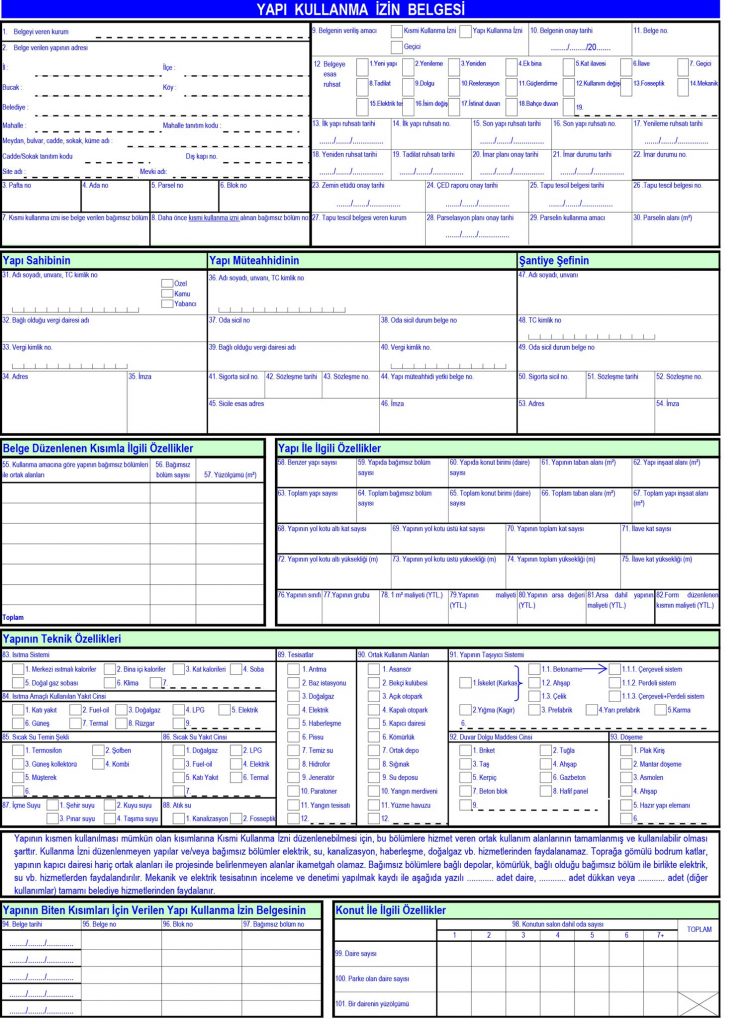
- A · Issuing authority — field 1
- Read “Belgeyi veren kurum”. Verify the issuer independently before using the contact details on a copy supplied by a seller.
- B · Property identity — fields 2–6
- Compare the address, pafta (map sheet), ada (block), parsel (parcel) and building block with the title and approved project. A similar street address is not enough.
- C · Full or partial coverage — fields 7–9
- Look for “Kısmi Kullanma İzni” and the units included. Permission for one completed block does not establish permission for every building on the site.
- D · Certificate reference — fields 10–11
- These are the certificate's approval date and number. Ask the authority to match them to its own record.
- E · Permit history — fields 12–19
- These refer to the underlying building permits and changes. They are not substitutes for the certificate reference above.
- F · Approved use and area — fields 55–57
- The section “Belge Düzenlenen Kısımla İlgili Özellikler” describes the part being certified. Distinguish it from the whole-building figures alongside it; do not read a total floor area as one flat's area.
Illustrative scenario, not a real transaction: imagine two blocks on one parcel. A seller provides a certificate for Block A while the flat you are viewing is in Block B. Matching ada and parsel would pass the first check but miss the coverage problem. Ask for confirmation covering Block B and the particular independent unit before treating the document as evidence for that flat.
How to check an iskân before paying a deposit
- Request the complete document. Obtain a legible copy, with any pages or attachments defining its coverage, from the owner or authorised representative. A cropped screenshot of the title is not sufficient.
- Match the property. Compare parcel, building block, use and independent-unit information with the current title record and approved plans. Ask for an explanation of any changed address or parcel reference.
- Confirm the record with the issuing authority. Supply the approval date, certificate number and property identifiers. Ask how the owner can obtain an official copy or authorise access; do not assume a prospective buyer can inspect every file without consent.
- Check coverage and subsequent changes. Have a suitably qualified architect or engineer compare the existing building with the approved project. An enclosed terrace, added room or changed use deserves a specific answer.
- Resolve the outstanding items in writing. Ask your independent lawyer to address missing approvals, responsibility for costs and any completion conditions before you commit money.
Didim Municipality provides a municipal online-services portal; its website also links to document verification. Ask the municipality which service supports your particular record. The absence of an online search result alone does not prove that a certificate was never issued.
A working electricity or water meter is not proof of iskân. Article 31 sets the general utility restriction, but temporary Article 11 provides conditional exceptions for certain buildings. Verify the certificate itself rather than inferring approval from an active subscription. Source: Zoning Law.
What must be ready before an application?
The building must meet the applicable permit, project and technical requirements. Under Article 64 of the Planned Areas Zoning Regulation, the application includes the relevant technical or building-inspection reports, an energy performance certificate where required, and building photographs. For partial permission, the shared areas serving the completed parts must also be ready for use.
Use the following as a preparation list for a normal permitted project, not as an exhaustive list for every building:
- Owner or authorised representative: application, ownership and property references; confirm identity and representation requirements with the authority.
- Architect and technical team: review the completed building against the approved projects and establish whether any changes need approval or physical correction.
- Building-inspection organisation, where applicable: completion and technical reports, inspection records and the closing paperwork for the supervised works.
- Owner and contractor: establish the status of the construction file's social-security clearance and outstanding assessed charges with the responsible bodies. Do not assume that a contractor's debt automatically becomes the buyer's liability.
- Relevant specialists: confirm any project-specific energy, lift, fire-safety or installation documents required for that building.
Didim's published Yapı Kontrol service table lists technical and completion reports, final inspection-payment paperwork and supporting records for its combined completion/iskân service. Request the current checklist for your parcel before collecting documents. For applications by a representative, the table calls for a notarised power of attorney; arrange its scope with your adviser before signing.
The municipal authority issues the certificate. A marketing business, estate agent or contractor cannot issue one on its behalf.
How many days does a habitation certificate take?
Article 30 states that the authority must conclude owners' applications within 30 days. That is not a promise that an unfinished building will have a certificate one month after its owner first asks about it. Project corrections and preparation of the application are separate from deciding the application. Read the statutory wording.
There is a local distinction worth checking: Didim's published service table describes its combined final inspection-payment, completion and iskân service as 30 working days. This is a service-table entry, not a replacement for the statutory 30-day wording or a measured local average. Ask the department to confirm the applicable process and start date for your file. Didim service table.
For planning, separate three periods: putting the file in order; the authority's assessment; and any subsequent title or utility work. Ask for the application receipt and a written list of missing items. We have not verified a reliable average turnaround for Didim and therefore do not present “two weeks” or “six weeks” as a local fact.
Article 30 also addresses applications not concluded within the statutory period. Do not treat silence alone as a substitute for a verified certificate in a purchase: the same article preserves responsibility for legal non-compliance. Have a lawyer assess the actual file before relying on that provision.
Habitation certificate costs and fees
Separate the municipal certificate charge from the cost of getting the building ready. Law 2464, Article 80(f), provides for a yapı kullanma izni harcı. That does not make every sum labelled “iskân costs” a municipal fee. The Ministry's explanation of the fee basis distinguishes the permit fee within the municipal revenue framework.
- Official charges
- Request an itemised assessment from the municipality, showing the current tariff or legal basis, the applicable area or unit basis and any exemption. Obtain an official receipt for payment.
- Technical and professional work
- Request separate quotations for any reports, project revisions, translation or representation actually needed. Check whether the original construction agreement already includes that work.
- Unfinished work and corrections
- Price missing installations or required alterations separately. A cheap certificate quotation tells you little if it excludes the work needed to make the building compliant.
- Other outstanding file items
- Identify any social-security clearance issue, assessed debt or separate title/utility cost. Ask who is legally and contractually responsible rather than accepting a combined unexplained total.
Why no single 2026 lira figure here? We could not verify a complete, current Didim tariff applicable to a specific example building. Quoting another municipality's rate as a Didim price would be misleading. For a usable estimate, send the municipality the parcel, approved use, building area and full/partial application details, then request a dated written breakdown.
Before accepting any quotation, ask: Is this for the whole building or my unit? Which official payments does it include? Are technical work and taxes included? What remains payable if the application cannot proceed? Who pays under the construction or sale agreement?
Questions buyers ask
Is a habitation permit the same as a habitation certificate?
In this context, yes: both English labels commonly refer to the yapı kullanma izin belgesi. Confirm the Turkish document name, property identity and coverage rather than relying on the translation.
Does a certificate prove the building is safe today?
Do not use it as a substitute for a current structural assessment or a condition survey. Later alterations and the building's present condition require their own checks.
What if the seller says the certificate is being processed?
Ask for the application reference, the authority's recorded status and outstanding requirements. An application is not an issued certificate. Have your lawyer address that distinction in the proposed agreement.
Can a foreign owner apply?
Ask the issuing authority which ownership, identity and representation documents it requires for your file. If you use a representative, confirm the power-of-attorney requirements; the building still has to meet the applicable technical conditions.
Sources and scope
This is an independent educational guide, not a municipal certificate-verification service or individual legal advice. Turkish official sources take precedence over the English explanations. Sources checked on 8 September 2026:
- Ministry: Zoning Law No. 3194 — Articles 30–31 and temporary Article 11; certificate, timing and utilities.
- Ministry: building-permit and occupancy-permit procedures — Article 64 requirements. This explanatory document is not a guarantee that every local checklist is unchanged.
- Didim Municipality: Yapı Kontrol service standards — combined completion/iskân entry and representation note; confirm current requirements with the department.
- Ministry: municipal planning fees and changes of use — discussion of Law 2464, Article 80; not a 2026 Didim price list.