The temple sits in the heart of Didim town centre (Yenihisar). It is ~10 minutes by car from Altınkum, ~15 minutes from Seyrantepe-Yeşiltepe and ~5 minutes from the bus station. Parking is available opposite the entrance and in nearby streets.
A Three-Thousand-Year Story
The Temple of Apollo is so woven into Didim's history that it has become an emblem of the district. Sitting at the heart of the Yenihisar neighbourhood, embedded in the streets of the modern town, this colossal temple was in antiquity more than a religious centre — it was one of the most important oracle sites of the whole Ionian world. The two enormous columns that still stand today are the unfinished legacy of one of the ancient world's most ambitious construction projects.
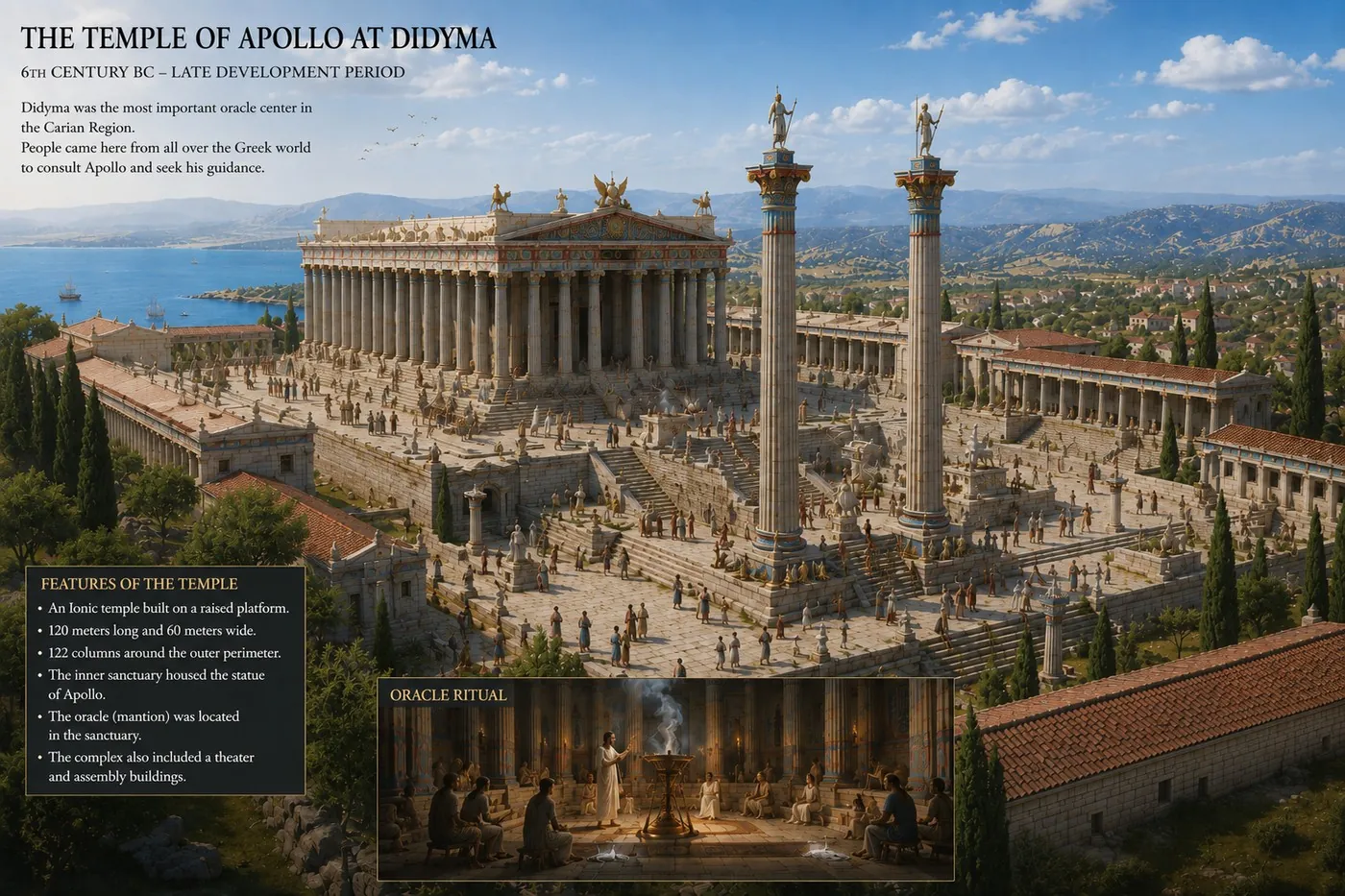
The story stretches back to the 8th century BC, perhaps earlier. It began as a small sanctuary administered by a priestly family, the Branchidae. As the cult of Apollo grew here, the first major temple was built in the 6th century BC. But when the Persians seized the region in 494 BC, they destroyed the temple and carried off the sacred statue and treasury to Susa. Roughly two centuries later, when Alexander the Great freed the region, work on a new temple began. The project was conceived on such a daring scale — 122 columns, 110 metres long, 60 metres wide — that despite six centuries of work, it was never finished.
Worth knowing: the Temple of Apollo is the third-largest temple of the ancient world, after the Temple of Artemis at Ephesus and the Temple of Hera on Samos. Had it been finished, it would have been the largest of all — but Rome, then Byzantium, and the gradual loss of regional importance left it permanently incomplete.
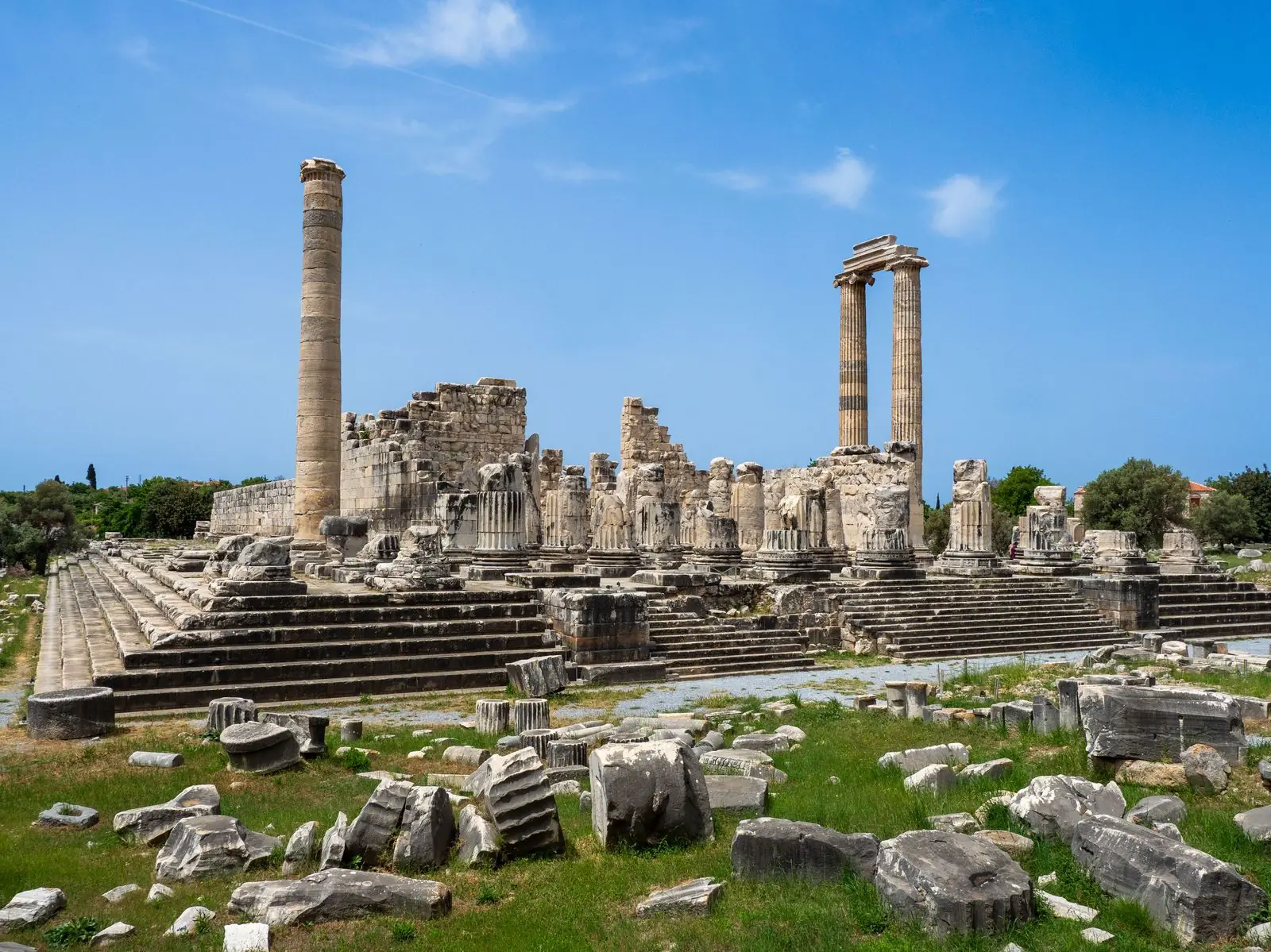
Architecture: Designed to Be the Largest in the World
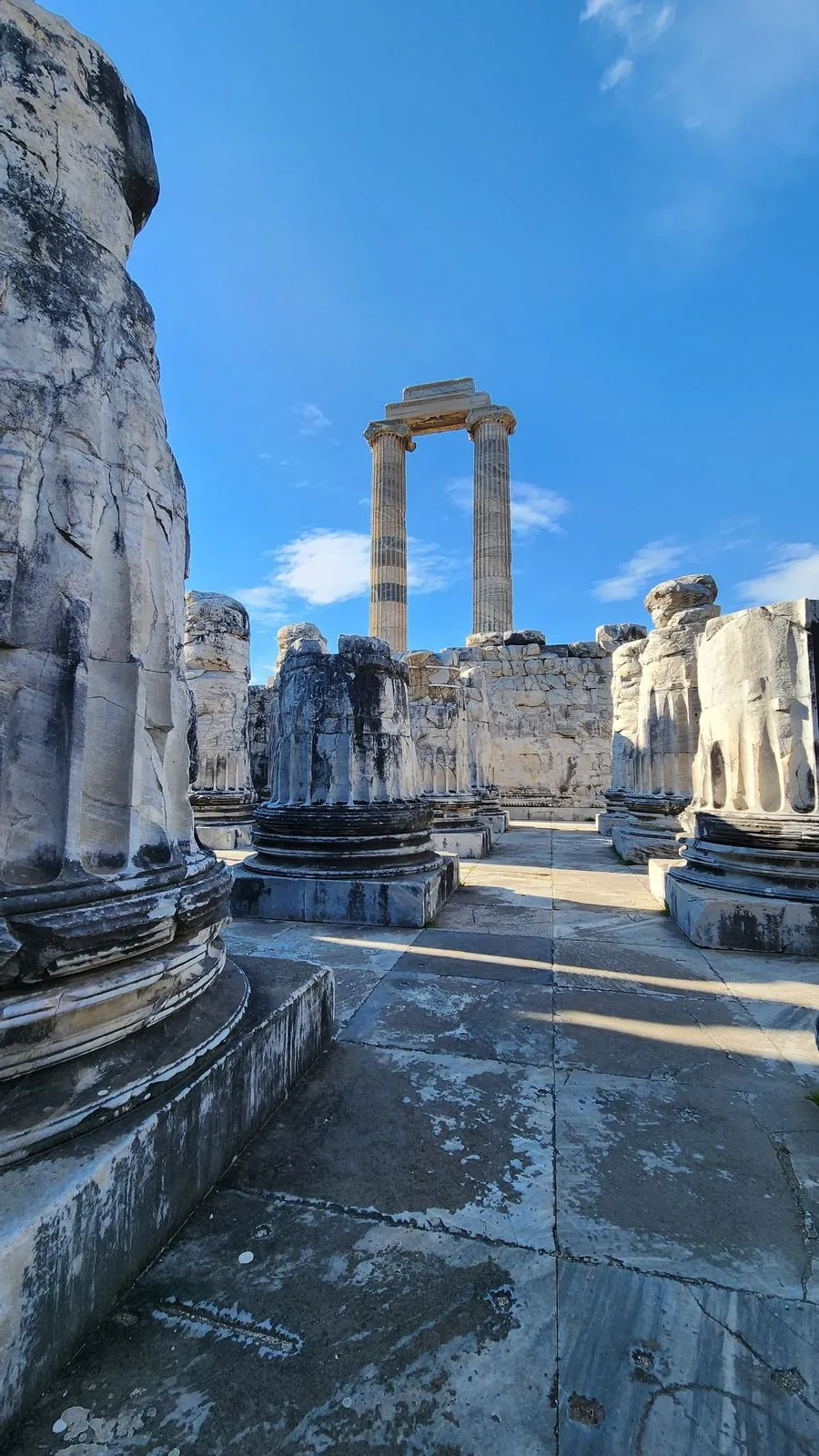
The temple's architectural features make an instant impression. Built in the Ionic order, the columns stand 19.7 metres tall — roughly the height of a six-storey building. Each column is made up of 12 drum stones, and each drum weighs 25 tonnes on its own. How stone blocks of this size were brought from the Carian marble quarries near Pamukkale to Didyma remains an engineering puzzle even today.
The temple sits on a two-stepped platform. From the outside you see the main hall ringed by two rows of columns (dipteral arrangement). The real surprise reveals itself inside: at the centre lies an open-roofed inner court (adyton) facing the sky. Within it stood a small second temple (naiskos) and the sacred spring. This double-shelled layout is one of the rare architectural solutions seen in only a handful of ancient temples.
Adyton (Inner Sacred Court)
The open-roofed central space facing the sky. This was the heart of the temple; the sacred laurel tree and Apollo's small statue (naiskos) stood here. Its double-walled design kept it hidden from outside view, and only those chosen for the oracle were admitted.
Adyton · Open courtThe Two Tunnels (Dromoi)
Two narrow, sloping tunnels lead from the front of the temple down into the adyton. Priests and oracle-seekers passed through these to reach the inner court. The vaulted ceilings are among the finest examples of ancient engineering; the acoustics have to be heard from inside to be appreciated.
Tunnel · Acoustic architectureColumns and Decoration
One of the two surviving complete columns is considered one of the best-preserved Ionic columns anywhere, with all of its original ornamentation in place. The volutes (scroll-like decorations) of the capitals and the griffin reliefs between them reflect the highest craftsmanship of the period.
Ionic order · VoluteThe Builders' Drawings
Inside the temple walls, archaeologists have found 1:1 scale technical drawings made by the master builders during construction — markings never meant to be visible in the finished temple. They are extraordinary evidence of the mathematical precision of ancient architects.
Ancient engineering · DrawingsThe Apollo Oracle: Voice of the Ancient World
The Temple of Apollo was more than a religious building — it was, after Delphi, the most important oracle of the ancient world. Kings, statesmen, generals, merchants and ordinary citizens travelled here for days to put their questions about the future. The Roman emperors Trajan, Hadrian and Julian wouldn't set out on a major campaign without consulting Apollo.
The process was elaborate. The petitioner first completed a purification rite in the outer temple. The oracle (prophetis) then drank from the sacred spring, fell into a trance and delivered the god's answers beneath the laurel tree in the adyton. The answers were typically given in ambiguous verse — dangerously clever statements that could be read in multiple ways depending on the petitioner's fate.
A famous moment of history: the oracle given to Emperor Trajan in the early 100s AD, before his Persian campaign, is among the most famous Apollo responses still displayed at the temple. Oracular activity at Didyma ended at the close of the 4th century AD, when the Byzantine emperor Theodosius banned pagan worship.
The Medusa Head and Other Details
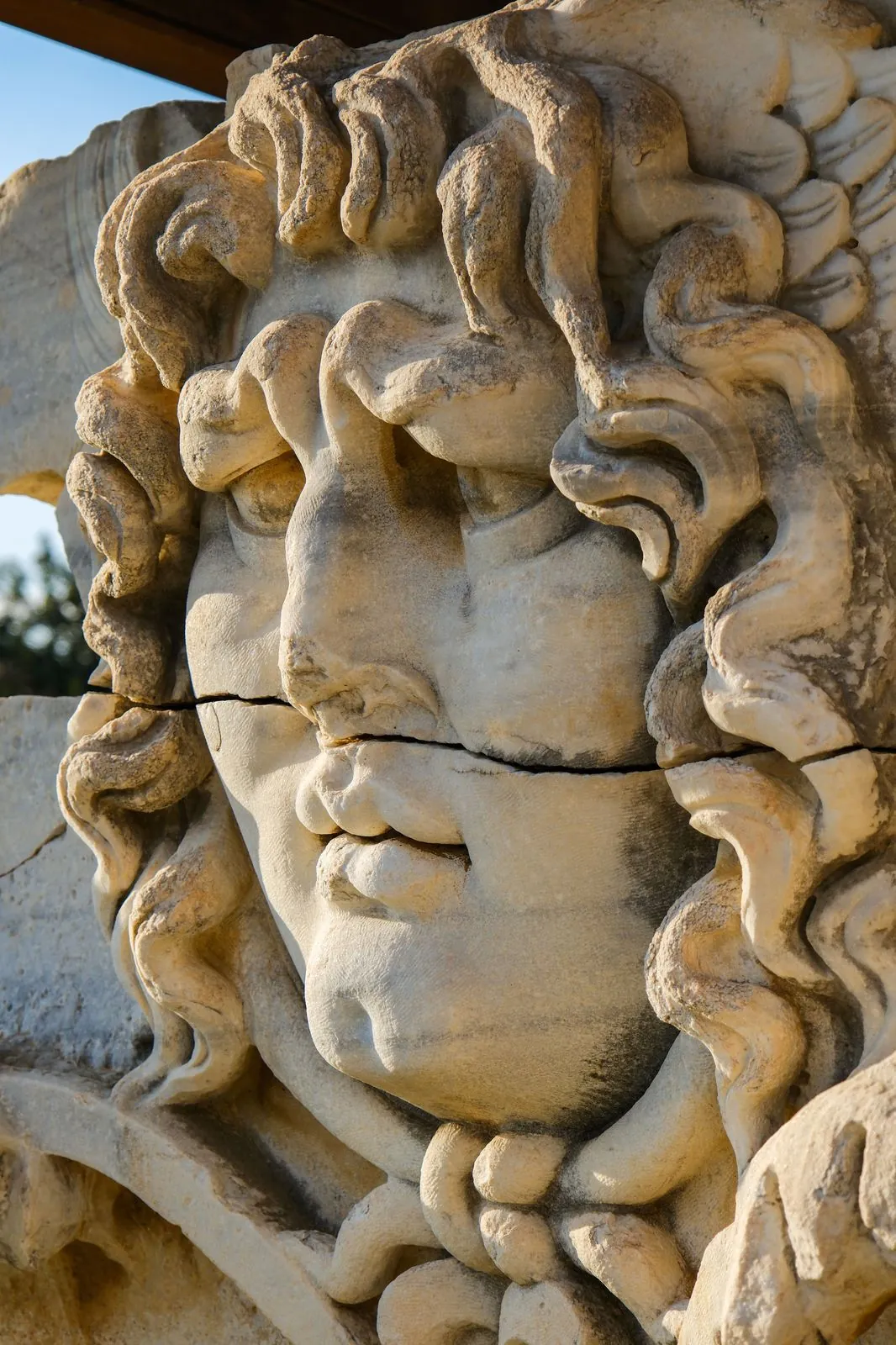
Perhaps the most photographed piece at the temple is the toppled Medusa head in front of the main entrance. This Roman-era relief is one of several pieces that fell from the frieze on the temple's façade. The face, framed by serpentine hair, is a perfect example of how ancient sculptors managed to gather both terror and beauty into a single expression. No visitor to the Temple of Apollo leaves without taking a photograph beside it.
Other important details include the lion-headed water spouts visible on the stepped platform, the griffin and mythical-creature reliefs arranged symmetrically along the front, and the large building blocks scattered around the site. Each block, with its numbering and mason's mark, shows the organisational capacity of the ancient construction site.
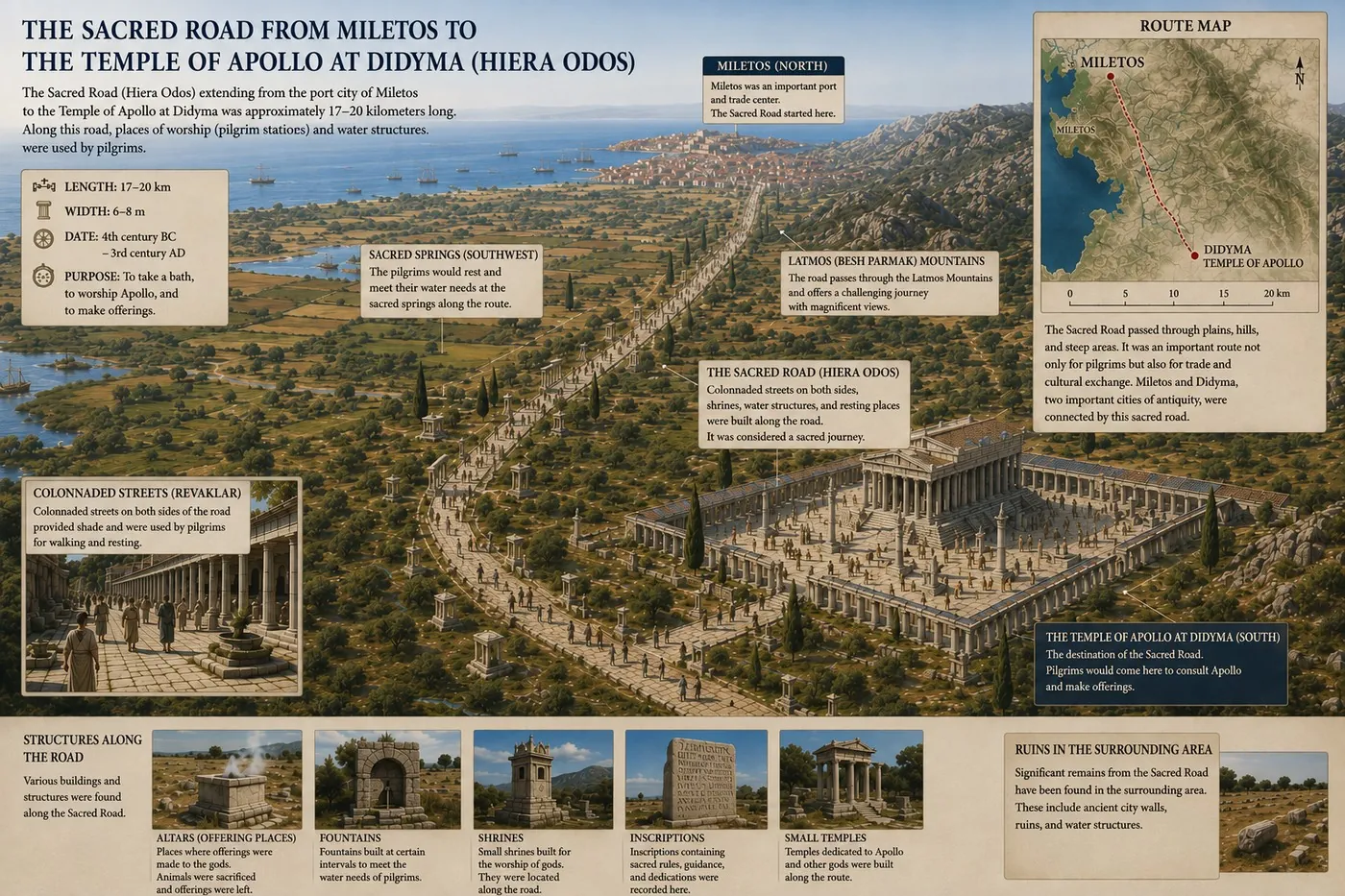
The Sacred Way: 17 km from Miletus to Apollo
In antiquity, a 17-kilometre Sacred Way (Hieros Hodos) ran between Miletus and the Temple of Apollo. Lined with statues, funerary monuments and rest stations, the road was a ceremonial route walked by thousands of pilgrims during religious festivals. Parts of it have been uncovered by excavation; rows of seated statues and lion figures are now displayed at the Pergamon Museum in Berlin.
A day-long walk along the route — from Miletus to the Temple of Apollo — is still organised today by some cultural-tour operators. For a history-minded traveller, the feeling of walking in the footsteps of the ancient Ionian pilgrims is unique.
How far is the Temple of Apollo from Seyrantepe?
The Temple of Apollo sits in Didim's central Yenihisar neighbourhood — making it the closest ancient site to our Seyrantepe and Yeşiltepe portfolio. You can plan a visit short enough to leave after breakfast and be back in time for lunch. With evening lighting in place, a post-sunset visit also makes for a memorable experience.
Distances to the Temple of Apollo
Such proximity to an ancient monument is a rare advantage anywhere in the world. A daily closeness comparable to the Forum in Rome or the Acropolis in Athens — in Didim it's the Temple of Apollo. Here, walking past an ancient temple each morning on the way to your day is an ordinary luxury.
Building plots 10 minutes from the Temple of Apollo
Our Seyrantepe and Yeşiltepe portfolio, next door to the third-largest temple of the ancient world.
Practical Information: Before You Go
Opening hours: summer (1 April – 1 October) 08:30 – 19:00; winter 08:30 – 17:30. The site is open every day. Holders of the Turkish Müzekart enter free.
Tickets: entry to the ancient site is paid; tickets are available at the gate or online via muze.gov.tr. For visitors based in Turkey, the Müzekart is a substantial annual saving.
Best season and times: spring (April–May) and autumn (September–October) are optimal. Summer afternoons can be very hot. Early morning or late afternoon visits offer the best light and photography. At sunset the temple stones turn a golden hue.
Duration: allow 1–2 hours. A quick visit takes about 45 minutes; a detailed look at the tunnels, the Medusa head and the columns runs to two hours. An audio guide or local guide is recommended.
Parking, toilets and souvenirs: there is free parking around the entrance, plus toilets, a small kiosk and shops selling antique-themed souvenirs. For genuine handcrafts, the streets of the Yenihisar neighbourhood are a better bet.
Combine with: the Temple of Apollo pairs ideally with a beach day at Altınkum — the temple in the morning, lunch and a relaxed afternoon by the sea. For history lovers, the trio of Ancient Miletus and Lake Bafa can be done in a single day.
Practical tip: the temple sits on a high platform with marble flagstones inside. They can be slippery in wet weather; comfortable, grippy shoes are recommended. In summer a hat, sunglasses and water are essentials.
Frequently Asked Questions
How do you get to the Temple of Apollo?
The temple is inside Didim town centre (Yenihisar) — about 10 minutes by car from Altınkum and 15 from Seyrantepe-Yeşiltepe; most local dolmuş minibuses pass the temple junction. The "Get Directions" link on this page starts navigation straight in Google Maps.
Is there parking at the Temple of Apollo?
Yes — there is parking opposite the entrance and in the surrounding streets. Midday in summer gets busy; early morning is easiest.
Is the Temple of Apollo in Didim?
Yes. The temple sits in the Yenihisar neighbourhood of Didim, in the heart of the town. Modern Didim is a town that grew up around the temple.
What was its ancient name?
The ancient name is Didyma. The word means "twin"; the site was dedicated to Apollo together with his twin sister Artemis. The modern district of Didim takes its name from this ancient root.
Why was the temple never finished?
Construction restarted in the 4th century BC and continued under Rome, but the scale of the project was so vast that even six centuries of work weren't enough. The spread of Christianity and the ban on pagan worship eventually brought construction to a permanent halt.
Is the Temple of Apollo a UNESCO site?
It is on the UNESCO Tentative List together with Miletus and Priene. The full listing process is ongoing.
Can it be visited with children?
Yes — it's very child-friendly. The open setting, the tunnels (you can walk down and back up), the large stone blocks to clamber between, and the Medusa head all hold children's attention. The only need for parental care is on the higher platforms.
Does the Müzekart work here?
Yes. The Turkish Müzekart provides free entry all year for residents. For someone living in Yenihisar it's a valuable annual saving.