The City Where Philosophy Was Born
Miletus was one of the most influential cities of the ancient world. The ruins that lie today near the village of Balat in the district of Didim, Aydın, bear the traces of an Ionian capital with four harbours, where philosophers were born, and where systematic scientific thought first took root. The city was founded on the shore of a bay at the mouth of the Büyük Menderes (ancient Maeander) River — just as with Lake Bafa, alluvial deposits gradually pushed the sea back, and the city today lies inland, partially buried in the plain.
The city's history reaches back to the 11th century BC, and even into the Bronze Age. The settlement, known as "Millawanda" during the Hittite period, later passed into the hands of the Ionians and became one of the most important of the twelve Ionian cities. In the 6th century BC, Thales — who proposed that water was the fundamental substance of the universe — was born here. Together with his successors Anaximander and Anaximenes, Miletus is considered the starting point of Western philosophical thought. The city is also where the mathematician Hippodamus first applied the grid plan system; the origins of modern urban planning, all the way to today's Manhattan, can be traced back to Miletus.
Worth knowing: Miletus was the capital of the Ionian Revolt (499 BC) against Persian rule. This uprising in turn sparked the Greco-Persian Wars. The site you visit today is therefore the first great fault line between Eastern and Western civilisations.
The Great Theatre: a 15,000-Seat Monument
The first structure most visitors encounter — and the one they remember best — is the Great Theatre. Built in the Hellenistic period and expanded by the Romans, the theatre still stands and could seat 15,000 spectators. From the upper tiers you can see the plain, the bed of the ancient harbour and, on the horizon, the direction of Lake Bafa. The acoustics remain striking: a sentence spoken at the centre of the stage can be heard clearly on the topmost row.
One of the most curious details are the inscriptions carved into the seats. The owners of certain seats can still be read, evidence of how seriously the people of Miletus took their theatre. The vaulted passages on the upper tier and the spaces behind the stage rank among the most intact examples of Roman-era architecture in Anatolia.
Other Monuments Worth Seeing
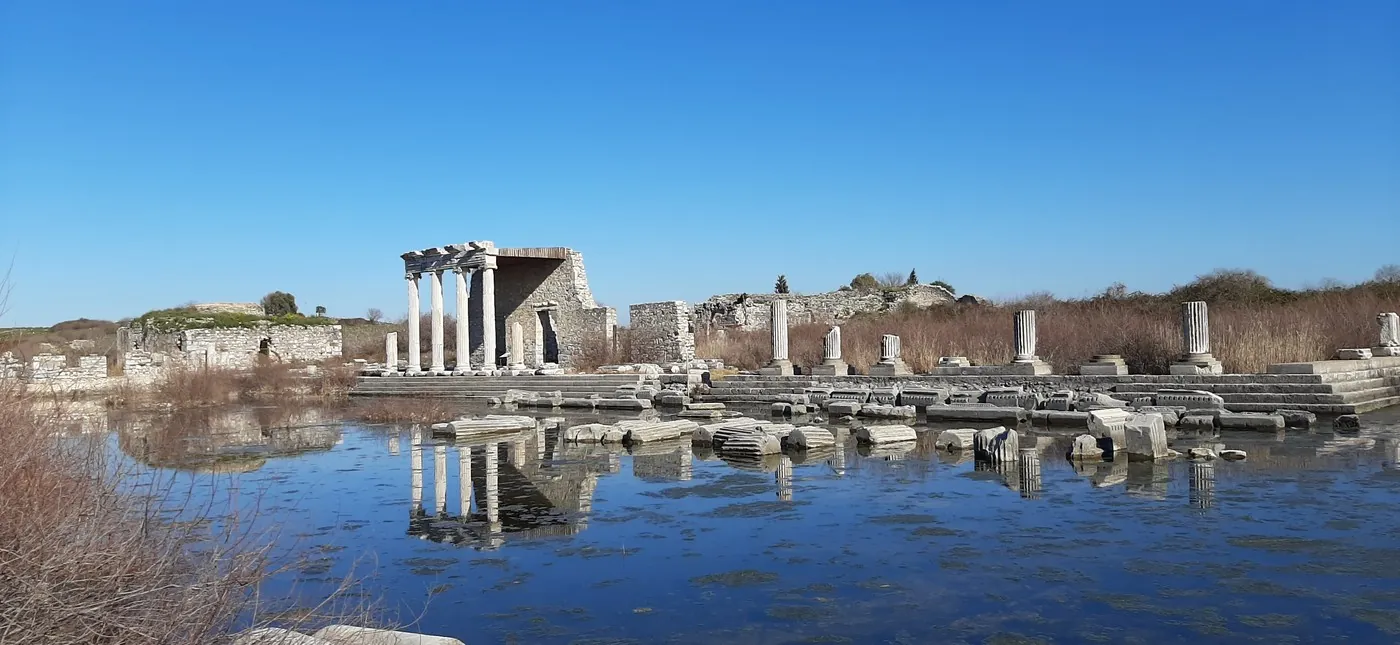
Miletus is far more than its theatre. A wide site covering the centre and streets of the ancient city contains baths, agoras, temples, council buildings and athletic structures. The route below covers the key stops for a roughly three-hour visit.
Baths of Faustina
Built in honour of Faustina, wife of the Roman emperor Marcus Aurelius, these baths are among the best-preserved Roman baths in Anatolia. The river-god statue at the head of the cold-water pool and the lion-headed fountain are still in place. The vaulted passages and traces of marble cladding are well worth seeing.
Roman · 2nd c. ADBouleuterion (Council House)
A semicircular council building where the political representatives of Miletus convened. It bears tangible traces of Hellenistic democratic practice. The semicircular tiers of seats and the remains of the monumental entrance gateway are particularly striking.
Hellenistic · 2nd c. BCDelphinion (Temple of Apollo Delphinios)
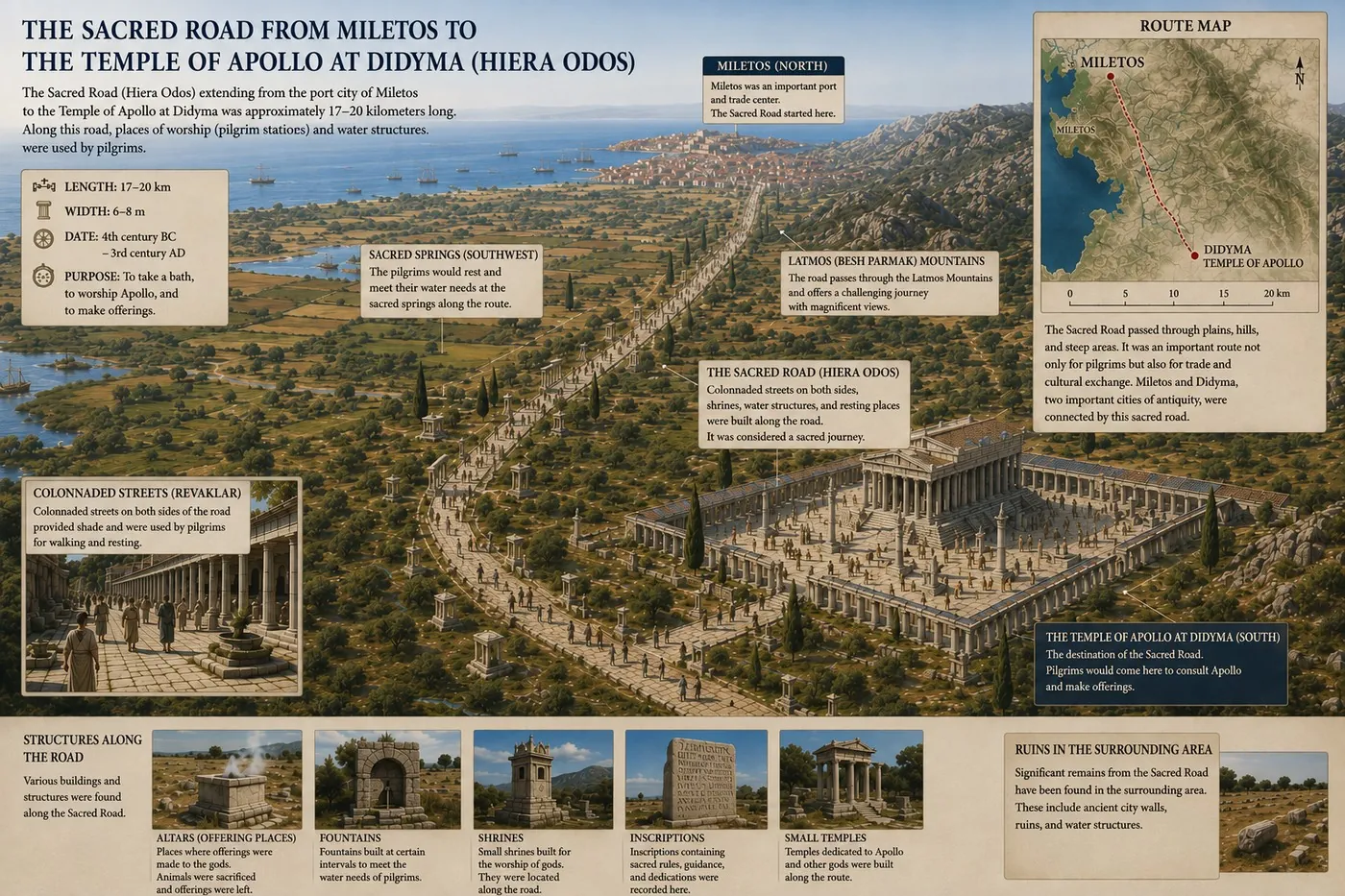
This sanctuary right by the harbour was the temple where sailors made vows to Apollo. It shares a religious bond with the Temple of Apollo at Didyma — it marks the starting point of the Sacred Way that led from Miletus to the temple.
Sacred Way · Cult of ApolloNorth and South Agora
Miletus had two agoras: the North Agora was devoted to religious and civic affairs, the South Agora to commerce. The South Agora, at a vast 196 × 164 metres, was one of the largest in the ancient world. The foundations of its columned porticoes are still traceable today.
Civic space · CommerceStadium
The stadium that hosted ancient athletic contests — especially the starting-line blocks and tiered seating — survives in good condition. As one of the pre-Olympic stadiums, it offers an important window onto ancient sporting culture.
Athletics · Sports architectureIonian Stoa and Baths of Capito
Among the commercial structures around the Lion Harbour, the Ionian Stoa, with its columned portico, was one of the longest stoas of its time. Adjacent to it stand the Baths of Capito — the second-largest Roman bath complex from antiquity to survive at the site.
Stoa · Roman bath architectureİlyas Bey Complex: Traces of Turkish-Islamic Heritage
Miletus is not only about its ancient remains. At the southern edge of the site stands the İlyas Bey Complex (1404), built during the Menteşe Beylik and one of the most refined examples of early Turkish-Islamic architecture in Anatolia. The complex — comprising a mosque, hamam and madrasa — underwent a comprehensive restoration in the 2010s and was awarded the Europa Nostra Award.
The stonework around the main portal of the İlyas Bey Mosque — particularly the looping geometric patterns and calligraphic details — ranks among the finest surviving work of its era in Anatolia. The mosque's single-domed prayer hall is simple yet impressive; the light filtering in through the dome's windows creates an atmosphere that captivates every visitor.
Don't miss: the carved crown portal of the İlyas Bey Mosque. It is considered one of the highest points reached by Turkish-Islamic stone craftsmanship in Anatolia. Visiting it on the same day as the ancient theatre takes you on a 2,500-year journey through architecture.
The Miletus Museum: Where the Finds Are Gathered
Adjacent to the ancient city, the Miletus Museum holds a substantial share of the artefacts unearthed during excavations. Over 4,000 objects are displayed, spanning the period from the Bronze Age to the Byzantine era. Some of the original river-god statues from the Baths of Faustina, commercial records from the agoras, funerary stelae and everyday utensils are among the museum's key collections.
One practical advantage: visit the museum first. The chronological arrangement along its corridors gives a visual account of how the ancient city evolved, so that when you walk through the ruins outside you can place each building in its historical period more easily.
How far is Miletus from Seyrantepe and Yeşiltepe?
Although Ancient Miletus is administratively part of Didim, it lies to the north of the town centre, in the direction of Söke. RedRock's portfolio in Seyrantepe and Yeşiltepe is surprisingly close to Miletus — at the perfect distance both for an afternoon outing and for entertaining international guests.
Distances to Ancient Miletus
How do I get to Ancient Miletus?
From Didim centre: head north on the Akköy road; once past Akköy, turn at the Milet/Balat sign. About 30 minutes.
From Seyrantepe / Yeşiltepe: join the D525 Söke–Milas trunk road and follow it north to the same Milet/Balat junction. About 32–35 minutes.
Both routes meet at the same signed junction; a 4 km paved village road brings you to the site. Comfortable with children too.
Start navigation in Google Maps35 minutes to the ancient city, 15 minutes to the sea
Browse our portfolio of residential building plots in Seyrantepe and Yeşiltepe.
Practical Info: Before You Go
Opening hours: 1 April – 1 October, 08:30 – 19:00; in winter, 08:30 – 17:30. The Miletus Museum is closed on Mondays, but the ancient city remains open.
Tickets: A combined ticket covers both the site and the museum. Müzekart holders enter free — a very worthwhile membership for residents of Türkiye.
Best season: Spring (April–May) and autumn (October). Summer temperatures can exceed 40 °C and shade is limited; an early-morning visit is recommended.
Time needed: Allow 2.5–3 hours for the museum and the ancient city. The İlyas Bey Complex is included in the same ticket and fits within this time. A rushed visit can be done in 1.5 hours, but it does not do the monuments justice.
Parking, toilets, café: Parking at the entrance is free. There are toilets and a small kiosk. Bring water — 1.5 litres per person in summer is advisable.
Recommended pairing: Miletus in the morning, lunch at Lake Bafa, then back via the Temple of Apollo — a perfect route taking in three of the ancient world's monumental landmarks in a single day.
Practical tip: The walking surfaces inside the site are stone, earth and partly uneven. Sandals or heeled shoes are not advisable — trainers or trekking shoes are strongly recommended. In summer, a hat and sunscreen are essential.
Frequently Asked Questions
How far is Ancient Miletus from Didim?
From the centre of Didim the drive is roughly 30 minutes via the Akköy road; from RedRock's areas in Seyrantepe and Yeşiltepe, around 32–35 minutes via the D525 Söke–Milas trunk road. Both routes meet at the Milet/Balat junction.
Are Miletus and the Miletus Museum different sites?
No. The museum is a two-minute walk from the entrance to the ancient city. The two are treated as a single complex and a single ticket covers both.
Can Miletus be visited in one day with the Temple of Apollo and Lake Bafa?
Yes. The classic full-day loop from Seyrantepe and Yeşiltepe is: Miletus in the morning, lunch around Lake Bafa, and an afternoon visit to the Temple of Apollo.
Is the site suitable for children?
Yes, but the upper rows of the theatre are steep, so take extra care with small children. The museum tends to engage younger visitors well, and the open layout of the archaeological site allows plenty of room to move.
Is Ancient Miletus on the UNESCO World Heritage list?
It is on the UNESCO Tentative List. The process to add it to the permanent list is ongoing, and conservation and restoration work continues at the site.